How to Share a Loved One's Story with Family Who Live Far Away
AI-generated image
The phone call comes at an impossible hour. Or maybe it's a message, a few words on a screen that change everything. Someone you love has died, and the first thing you want is to be with the people who understand what that means. Your sister. Your cousin. Your father's oldest friend.
But your sister is in Sydney. Your cousin is in Boston. Your father's oldest friend is in a village in Kerry and doesn't travel well anymore. And you're sitting in your kitchen, thousands of miles from where you grew up, holding a phone that suddenly feels like the loneliest object in the world.
This is the reality of grief in a scattered family. The funeral happens in one place, but the people who need it most are everywhere else. And after the funeral, when the real work of remembering begins, the distance doesn't get easier. It just gets quieter.
Why distance makes grief harder
Grief is, at its core, a shared experience. The rituals that cultures have built around death, funerals, wakes, removal nights, the gathering of people in a room with too much food and not enough chairs, exist because mourning was never meant to be done alone. When someone dies, we need to be with people who knew them. We need to tell the same stories, laugh at the same memories, sit in the same silence.
Distance takes that away. You can't hug someone over a video call. You can't sit together in a quiet room and simply be sad. You miss the small, unplanned moments of communal grief, the story someone tells while making tea, the photo that falls out of a book, the unexpected laugh that breaks through the heaviness.
There's also a specific kind of loneliness that comes from grieving in a place where nobody around you knew the person who died. Your colleagues say they're sorry, and they mean it, but they never met your mother. Your friends bring food and kindness, but they can't tell you the story of the time she got lost on a family holiday and somehow ended up having dinner with strangers who became lifelong friends. The people who carry those stories are far away, and the gap between your grief and the world around you can feel enormous.
None of this means that distance makes grief impossible. It means it requires more intention. The connection that happens naturally when everyone is in the same room has to be created deliberately when they're not.
Start with what you have: photos, voice notes, letters
You don't need a plan or a platform or a project. You just need to reach out.
Pick up the phone. Not to text. To call. The sound of another person's voice, someone who loved the same person you loved, is one of the most powerful things in early grief. Call your siblings. Call your aunts and uncles. Call the friends who knew them best. You don't need to have anything prepared to say. "I just needed to hear your voice" is enough. "I keep thinking about the time Mam…" is enough. These conversations won't fix anything, but they close the distance for a few minutes, and in those minutes, you're grieving together.
Start a group message. This sounds simple because it is. A WhatsApp group, a family text thread, whatever your family already uses. Name it something that feels right. Share a photo. Say "I found this today and it made me think of Dad." Watch what happens. Someone will reply with another photo. Someone else will share a memory. The thread becomes a quiet, ongoing space where the person is still present in the conversation, even if only in fragments.
Share photos as you find them. In the days and weeks after someone dies, photos surface everywhere. On your phone, in email attachments, in the back of a drawer. Don't wait until you've sorted them. Send them as you find them, one at a time, to the people who'll understand. A photo of your grandmother at Christmas in 1993, sent to your siblings with nothing more than "look at her," can carry more comfort than any sympathy card.
How to bring family together around a memory of someone who died
As the initial shock fades, some families want to do something more intentional. Not everyone does, and that's fine. But if you feel the pull to gather your family's memories of someone into something shared, there are ways to do it that don't require everyone to be in the same place.
A shared photo album. Google Photos, iCloud, or any shared album service lets multiple family members contribute photos to one collection. Create an album named after the person, share it with the family, and ask everyone to add what they have. You'll end up with photos spanning decades, from sources you didn't know existed. A niece in London adds a photo from a christening in the 1990s. An uncle uploads a scan of an old wedding portrait. Slowly, a fuller picture of a life comes together.
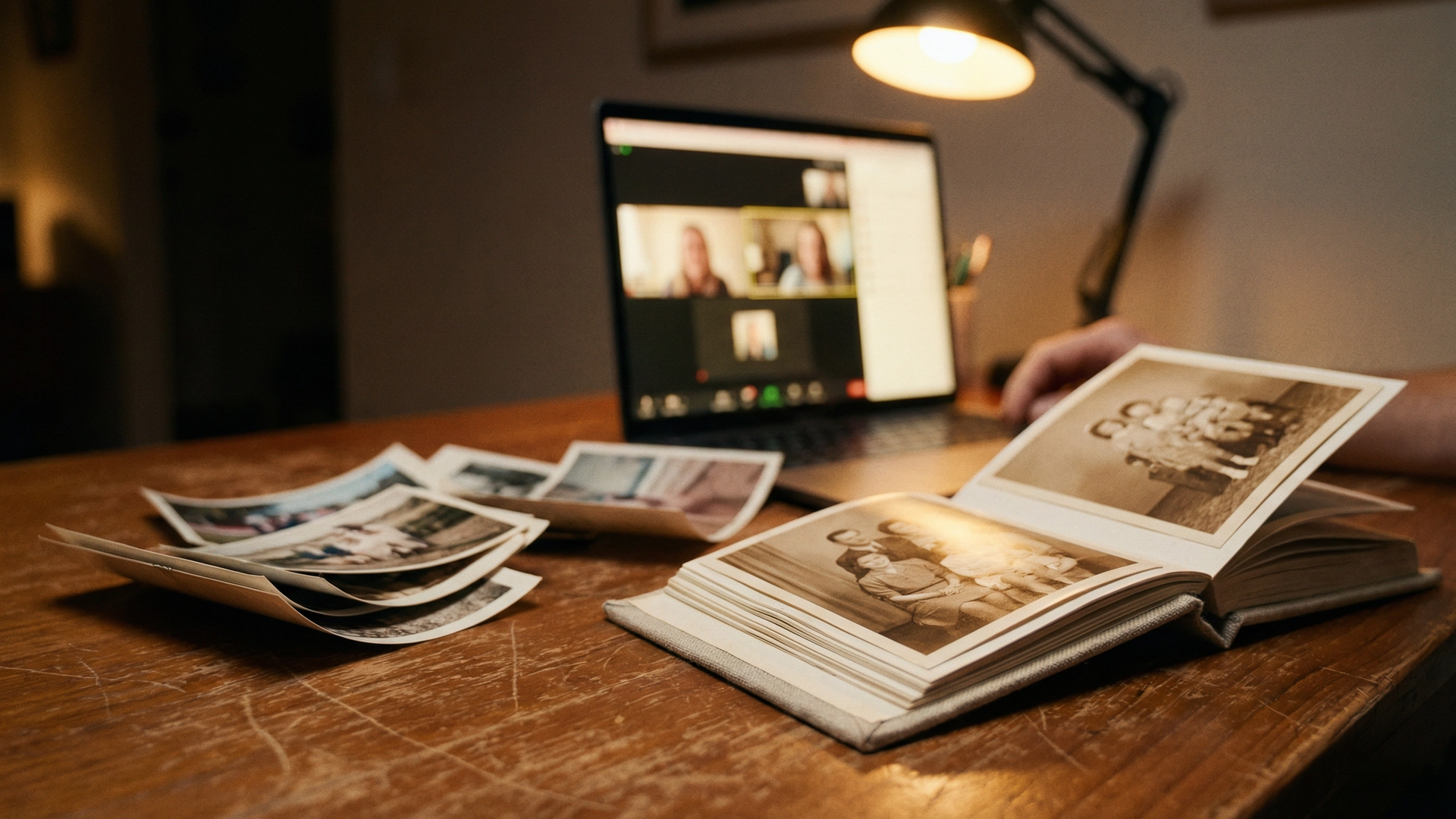
A video call on a meaningful date. Some families arrange a call on the person's birthday, or on the anniversary of their death, or on a day that held particular meaning, a wedding anniversary, the first Sunday of the GAA season they never missed, Christmas morning. It doesn't need to be formal. It can just be half an hour where everyone tells a story or shares a memory. The point is being together, even through a screen, on a day when the absence is felt most sharply.
Letters and recordings. Not every family communicates best through technology. For some, the most meaningful contribution is a handwritten letter about what the person meant to them, or a voice recording of a story they want to preserve. These can be gathered by one family member and shared with the rest. There is something about the physicality of a letter, or the sound of someone's voice breaking as they tell a story, that digital text can't quite replicate.
Ask for stories, not just condolences. When someone dies, people say "I'm sorry for your loss" because they don't know what else to say. But what grieving families often want most is stories. If you reach out to the people who knew the person, not just family but friends, colleagues, neighbours, and ask "what do you remember about them?" you will hear things that astonish you. Stories you never knew. Sides of the person you never saw. These stories are a gift, and gathering them is one of the most valuable things you can do. If you're not sure how to ask, or how to shape those stories into something lasting, our guide on how to write a tribute to someone who has died offers practical help with finding the right words.
Creating a shared online memorial for family far away
At some point, many families realise they want somewhere to put all of this. The photos are scattered across three group chats. The stories exist in emails and voice notes and conversations that are starting to fade. The video from the funeral is on someone's phone but nobody else has seen it.
An online memorial solves this by giving everything a home. One place where every photo, every story, every tribute lives together, accessible to anyone in the family from anywhere in the world. The sister in Sydney and the cousin in Boston and the old friend in Kerry can all visit the same space, contribute to it, and return to it whenever they need to.
What makes this different from a social media post or a shared photo album is permanence and purpose. A Facebook post about your father will be buried under the feed within days. A shared Google album is useful but functional, not something you'd describe as a tribute. An online memorial exists solely to honour one person. Every photo, every word is there by intention. It can be private or shared. It grows over time as more people add their memories. And it will still be there in five years, or ten, when a grandchild wants to know who this person was.
If you're considering creating one, the process is simpler than you might think. Our step-by-step guide on how to create a meaningful online memorial for a loved one covers everything from gathering photos to inviting contributions.
How to get reluctant family members involved
Not everyone in a family will respond to the idea of a shared memorial or a group chat about memories with the same enthusiasm. Some people grieve privately. Some are uncomfortable with technology. Some aren't ready yet and may not be for months or years. All of this is normal and deserves respect.
For older relatives who aren't comfortable with technology. Don't ask them to set up an account or navigate a website. Ask them for their stories in whatever medium feels natural to them, a phone call, a letter, a conversation over a cup of tea, and then, with their permission, add those contributions yourself. An 80-year-old grandmother who can barely use her phone may have the most important story of all. Meet her where she is.
For family members who grieve privately. Some people process grief internally and find public sharing uncomfortable. Don't push them. Let them know the space exists and that they're welcome to visit it or contribute to it whenever they're ready. Some of the most moving contributions to family memorials arrive months or years after the death, from the person everyone assumed didn't want to participate.
For children and young people. Children grieve differently and often need different ways to express it. A teenager might want to write something. A younger child might want to draw a picture or choose a favourite photo. Including children in the process of remembering, in age-appropriate ways, helps them understand that the person mattered and that it's OK to talk about them.
For family members you're not close to. Death sometimes reconnects people who have drifted apart. A distant cousin you haven't spoken to in years may carry a memory of the person that nobody else has. Reaching out doesn't have to be awkward. "I'm putting together some memories of [name] and would love to include anything you remember about them" is enough.
Keeping the connection alive over time
The hardest part of grief across distance isn't the first weeks. It's the long stretch afterwards, when the phone calls thin out, the group chat goes quiet, and everyone returns to their lives in their separate corners of the world. The person who died becomes someone you think about alone rather than someone you remember together.
This is where small, deliberate acts of remembrance matter.
Anniversaries and birthdays. Send a message on the day. "Thinking of Dad today. It would have been his 75th." That single sentence gives everyone else permission to feel what they're feeling and to say something back. It reconnects the family around the absence, even briefly.
The ordinary moments. Grief doesn't only arrive on significant dates. It arrives on a Tuesday in March when you hear a song they loved, or when you cook their recipe and it doesn't taste right, or when something funny happens and your first instinct is to ring them. Share those moments when they come. "Mam would have had something to say about this." They're small, but they keep the person alive in the family's daily language.
Adding to the memorial over time. If your family has created a shared space for memories, return to it. Add the photo you found while clearing out the attic. Write down the story you remembered while driving last week. A memorial that grows over the years, with new contributions appearing on birthdays and anniversaries and ordinary days, becomes something richer and more true to life than anything created in the first weeks of grief.
Distance doesn't diminish love
There is a particular kind of grief that belongs to the person who lives far from home. The guilt of not being there. The ache of missing the funeral, or attending but having to fly back before the family was ready to let you go. The loneliness of carrying someone's memory in a place where nobody else carries it too.
But distance doesn't diminish what someone meant to you. It doesn't lessen the love or the loss. It just means you need a place to put it, a way to connect with the other people who carry the same weight, across the miles and the time zones and the silences.
The technology matters less than the intention. A phone call, a shared photo, a story written down and sent to someone who'll understand, these are the threads that hold a scattered family together around a memory. Find the way that works for your family, and then keep showing up. Keep sending the photo. Keep telling the story. Keep saying the name.
The people who live far away need it most.
Left This World helps families create lasting online memorials, a dedicated space to bring together photos, stories, and tributes from everyone who loved them, no matter where in the world they are. Create a memorial >
Frequently Asked Questions
A place to remember, whenever you need it
Create a memorial page your family can return to — today, next year, and for years to come.