How to Write an Obituary: A Practical Guide with Examples
AI-generated image
Someone has died and now there is a thing to be written. A notice to go in the paper, or online, or both. Something that tells the world this person existed, that they mattered, and that there is a funeral or memorial service people might want to attend.
You have probably never written one before. Most people haven't. And sitting down to summarize a whole life in a few hundred words, while also trying to remember the name of the funeral home and the address of the cemetery or crematorium, is not something anyone should have to do while grieving. But here you are. So let's make this as straightforward as possible.
What an obituary is (and how obituaries work)
There is some confusion between obituaries, death notices, tributes, and eulogies. They overlap, but they are different things, and knowing the difference helps you write the right one.
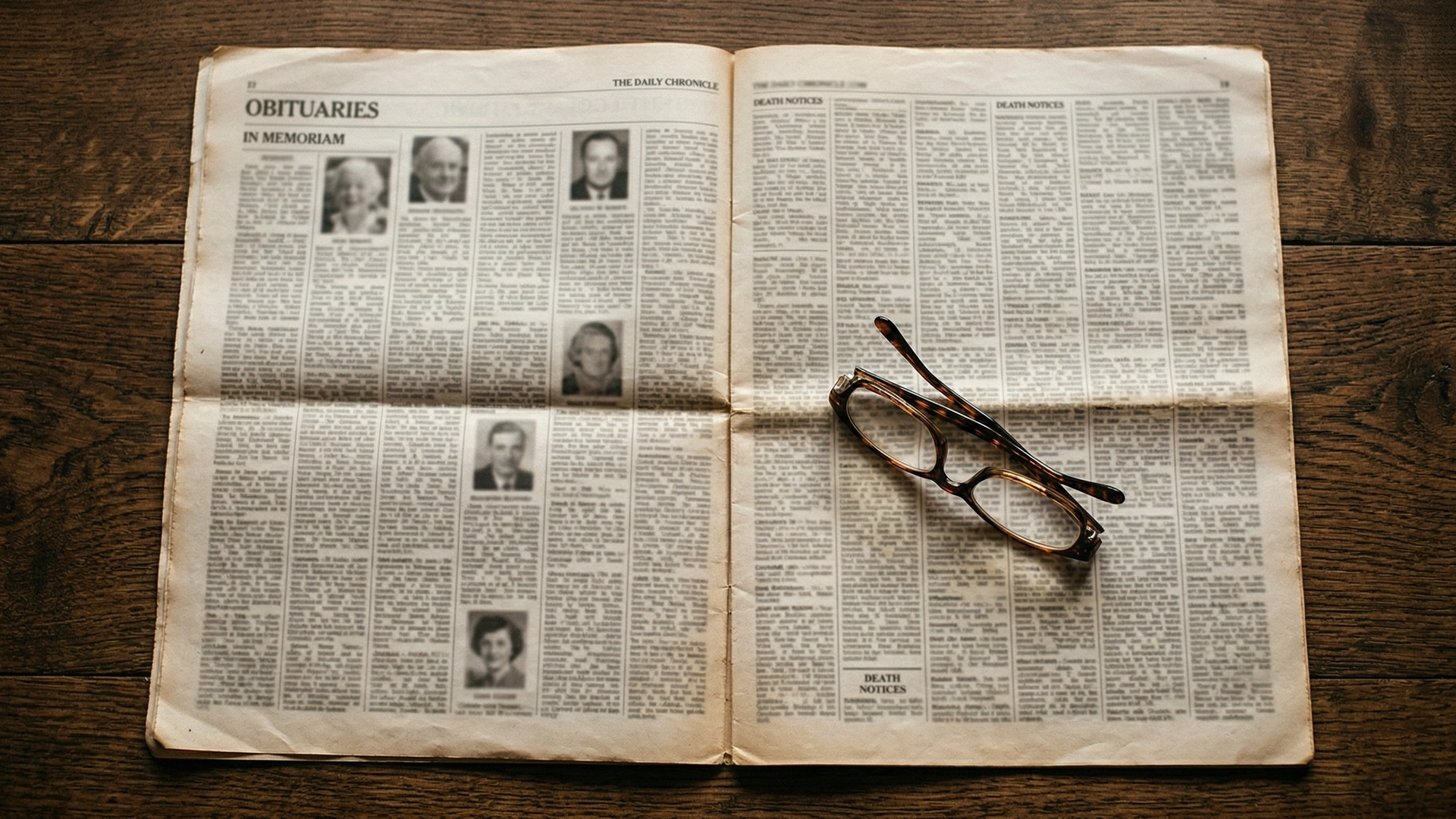
A death notice is a short, factual announcement. It states that someone has died and gives the details of the funeral or service. It is usually just a few lines, published in a newspaper or on a site like Legacy.com. Think of it as the practical notification.
An obituary is longer and more personal. It tells the story of a life, however briefly. It still includes the practical details, the date of death, the funeral arrangements, but it also includes who the person was: where they grew up, what they did, who they loved, and what they'll be remembered for. An obituary can run anywhere from 150 to 600 words, depending on where it will be published and what you want to say.
A tribute is more emotional and less structured than an obituary. It is your personal account of what someone meant, told through stories and memories. Tributes are often written for memorial pages, shared at funerals, or posted on social media. If you're looking to write something more personal, our guide on how to write a tribute to someone who has died covers that in detail.
A eulogy is a tribute delivered aloud at a funeral or memorial service.
This guide focuses on the obituary: the written record of a life, published to inform people and to honor the person who has died.
What to include in an obituary
An obituary doesn't need to follow a rigid template, but most include the same core information. Here is what to cover, roughly in order.
The announcement. The person's full name (including maiden name or any names they were known by), their age, where they lived, and the date they died. If the family is comfortable sharing it, the cause of death. There is no obligation to include the cause. Some families do, some don't. Both are fine.
Who they were. Where they were born and grew up. Their education, if relevant. Their career or the work that defined them. This doesn't need to be a résumé. A sentence or two about what they did and where they did it gives readers enough context to place the person.
Their family. Who they are survived by: spouse or partner, children, grandchildren, siblings, parents (if still living). Many obituaries also mention those who died before them, particularly a spouse or a child. The convention is "survived by" and "predeceased by," but you can use whatever language feels natural.
What made them who they were. This is the part that lifts an obituary from a factual record into something human. Their interests, passions, and habits. The things they loved. The way they spent a Sunday. Their sense of humor, their stubbornness, their kindness. You don't need much. Even a single sentence, "He could fix anything with a roll of duct tape and an unreasonable amount of optimism," tells someone more about a person than a paragraph of dates and job titles.
Funeral details. The date, time, and location of the funeral, memorial service, or celebration of life. Whether it is open to all or family only. Whether flowers are welcome or if the family prefers donations to a specific charity. If there is a reception or gathering afterwards, include the details.
Charitable donations. If the family would like donations in the person's memory, name the charity and, if possible, include a link or a reference number.
What to leave out of an obituary
An obituary is a public document. It will be read by people you know and people you don't. A few things are worth thinking about before you publish.
Family disagreements. If there are estranged family members, complicated relationships, or unresolved tensions, the obituary is not the place to air them. You don't need to pretend everything was perfect, but you also don't need to settle scores in print.
Anything the family hasn't agreed to. Check with close family members before publishing. Would they want the cause of death included? Are there ex-spouses or step-children who should or shouldn't be named? Is there anything the person themselves would not have wanted made public? A quick conversation avoids hurt feelings.
Excessive detail about the death itself. The date and, optionally, the cause are enough. The circumstances of a death are private unless the family chooses to share them.
How to write an obituary: step by step
If you've never written an obituary, the blank page can feel daunting. Here are some things that help.
Gather the facts first. Before you try to write anything, collect the essential information: full name, date of birth, date of death, names of surviving family members, funeral arrangements. Having these on hand means you're not stopping every other sentence to check a date or a spelling.
Read a few examples. Look at the obituary section of your local newspaper or browse Legacy.com. You'll quickly get a feel for the length, tone, and structure that's standard. You'll also notice that the ones that stand out are the ones that include something specific and human, a detail that makes the person feel real on the page.
Write like you talk. An obituary is not an essay. It doesn't need elaborate language or formal phrasing. If you would say "Mom loved baseball and couldn't boil an egg," write that. The best obituaries sound like someone who knew the person telling you about them.
Keep it to the length you need. If you're publishing in a newspaper, length affects cost. A short 150-word obituary might cost under $100 in a small-town paper, but several hundred dollars in a major metro paper. Longer obituaries in cities like New York or Chicago can exceed $1,000. For online publication, length is less of a constraint, but brevity is still a virtue. Say what matters. Leave out what doesn't.
Don't worry about being a writer. Nobody reads an obituary expecting literary prose. They're reading it because someone has died and they want to know who that person was. Honesty and warmth matter infinitely more than elegance.
A simple obituary structure to follow
If it helps to have a shape, this structure works for most obituaries.
Paragraph one: The announcement. Name, age, location, date of death.
Paragraph two: Early life. Where they were born, where they grew up, their education or early career.
Paragraph three: Their adult life. Career, marriage, family, the things that defined their middle years.
Paragraph four: What they loved. Interests, passions, personality, the things people will remember.
Paragraph five: Surviving family. Who they leave behind.
Paragraph six: Funeral or memorial details. Date, time, location, flowers or donations.
You don't have to follow this structure. Some of the best obituaries throw it out entirely and tell a single story that captures everything about the person. But if you're stuck, this gives you a path through it.
Obituary examples (short and long)
These are fictional examples to show what different approaches look like.
A short, traditional obituary:
Margaret Anne Thompson (nee Collins), aged 82, of Harrogate, North Yorkshire, died peacefully at home on 14 March 2026, surrounded by her family. Born in Leeds in 1943, Margaret trained as a nurse at St James's Hospital before marrying David in 1967. She worked as a district nurse for 30 years, retiring in 1998. Margaret is survived by her husband David, her children Sarah and James, and her five grandchildren. She was predeceased by her son, Robert, in 2011. A private funeral service will be held at St Peter's Church, Harrogate, on 22 March at 11am, followed by a reception at the family home. Family flowers only, please. Donations in Margaret's memory may be made to Macmillan Cancer Support.
A warmer, more personal obituary:
David Arthur Brennan, 67, of Bristol, died on 2 January 2026 after a short illness, which he handled with the same quiet stubbornness he brought to everything else. David was born in Cork in 1958, moved to England in his twenties, and never quite lost the accent. He spent 35 years as an electrician, mostly self-employed, mostly running late, always doing the job properly. He married Anne in 1985 and they had three children: Ciara, Liam, and Roisin. He was a dedicated, if not especially talented, golfer, a crossword enthusiast, and the kind of neighbor who would appear with a toolkit before you'd finished describing the problem. He is survived by Anne, his three children, and his seven grandchildren, all of whom he adored and none of whom he could keep up with. Funeral details to follow.
Both of these work. The first is formal and conventional. The second is warmer and gives you a sense of the person. Neither is better. The right approach is whichever one feels most like the person you're writing about.
Where to publish an obituary (newspapers, online, social media)
Obituaries in the US are most commonly published through the local newspaper, often via Legacy.com, which handles obituary submissions for many papers nationwide. Costs vary widely by city and length. A short 150-word obituary can cost under $100 in a small-town paper or $400 to $800 in a major metro paper. Longer obituaries in cities like New York or Chicago can exceed $1,000. Your funeral home will usually submit the obituary on your behalf.
Your funeral home's website will often host a notice at no extra cost. Legacy.com also allows families to post obituaries with condolence features. For something more lasting and personal than an obituary, an online memorial allows you to gather photos, stories, and tributes from everyone who knew the person, not just the few hundred words a newspaper allows.
The difference between an obituary and a memorial
An obituary does something important: it announces a death, records a life, and tells people where to come. But it does these things within tight constraints, a word limit, a format, a single moment in time.
A memorial does something different. It grows. It gathers contributions from people across the person's whole life, friends, family, colleagues, neighbors, each adding a piece of the picture that no single person could have written alone. It lives online permanently, not behind a paywall or buried in last week's newspaper. And it belongs to the family, not to a publication.
Many families do both: a newspaper obituary for the immediate announcement and an online memorial for the lasting, collaborative record of a life. Our guide on how to create a meaningful online memorial walks through the process step by step.
Writing your own obituary in advance
This might feel uncomfortable, but some people choose to write their own obituary while they're still alive. It is not morbid. It is practical, and it is a kindness to the people who would otherwise have to do it while grieving.
If you're planning your digital legacy and thinking about what you'd like to happen after you die, writing your own obituary is one of the most useful things you can do. You know the facts of your life better than anyone. You know which achievements mattered and which didn't. You know how you'd want to be described, and what you'd want left out.
Keep it in the same place as your other important documents, with your will, your passwords, and your wishes for your funeral. Tell someone where to find it. If you'd like a broader guide to organizing your digital life for your family, our piece on digital legacy planning covers the whole process.
It doesn't have to be perfect
The person you're writing about wouldn't care whether the sentences are elegant or the structure is textbook. They'd care that someone sat down, thought about their life, and tried to put it into words.
An obituary is a small thing, a few hundred words in a newspaper or on a screen. But it is also the last public act of recognition for a person who lived. It says: they were here. This is who they were. And they mattered.
That is enough. And so are you, for writing it.
Left This World gives families a lasting space to go beyond the obituary, gathering photos, stories, and tributes from everyone who loved them. Create a memorial →
Frequently Asked Questions
A place to remember, whenever you need it
Create a memorial page your family can return to — today, next year, and for years to come.